Supermassive Black Holes
At the geometric center of almost every large galaxy rests a gravimetric titan: a supermassive black hole containing anywhere from millions to tens of billions of solar masses compressed beyond the boundaries of classical physical reality.
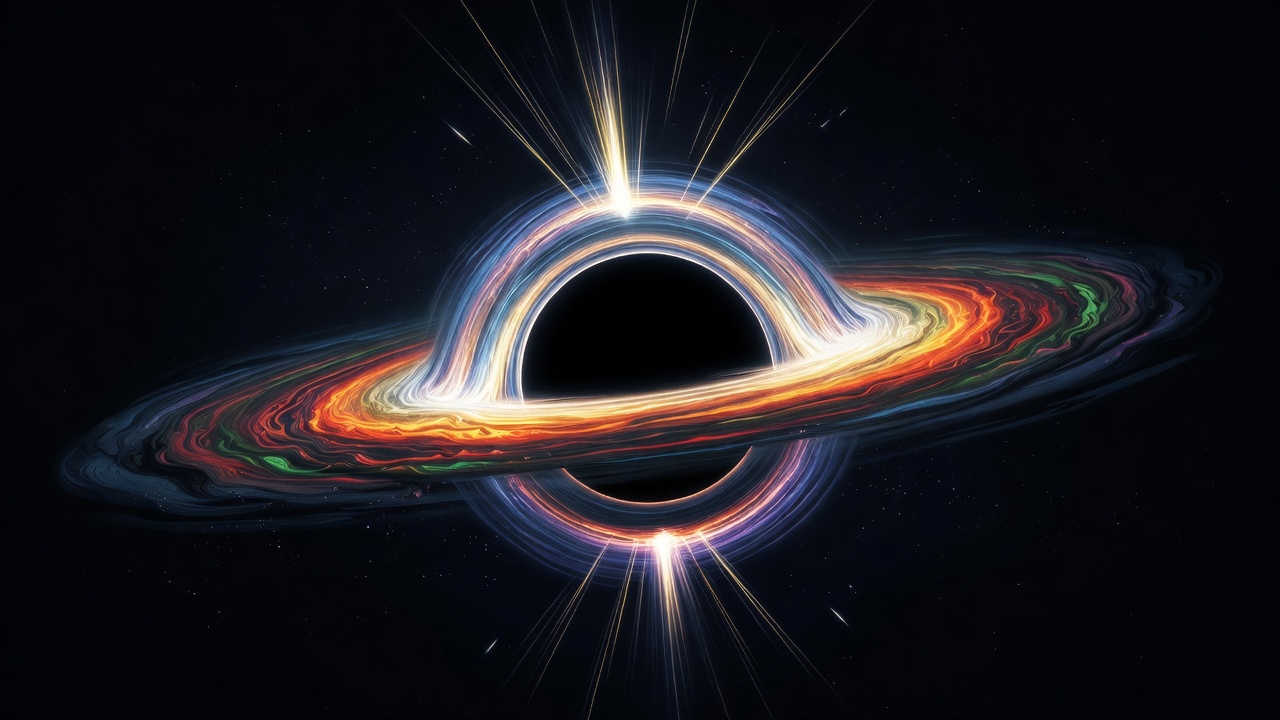
The Geometry of the Kerr Metric
In nature, black holes possess angular momentum. Described mathematically by the Kerr solution to Einstein's field equations, a rotating black hole does not merely pull matter inward; it drags space-time itself around in an orbital vortex.
This phenomenon, known as frame dragging or the Lense-Thirring effect, creates an external boundary outside the event horizon called the ergosphere. Inside the ergosphere, space-time moves faster than the speed of light relative to an observer at infinity; no object can remain stationary, regardless of its engine thrust. Through the Penrose Process, rotational energy can theoretically be extracted from this zone with remarkable thermodynamic efficiency.
Accretion Disks and Quasars
When infalling interstellar gas approaches a supermassive black hole, it cannot fall directly past the event horizon due to angular momentum. It flattens into a superheated, rapidly shearing accretion disk.
Differential rotation creates immense magnetic turbulence and viscous friction, heating the plasma to hundreds of millions of Kelvin. While thermonuclear fusion in ordinary stars converts less than 0.7% of rest mass into energy, a rapidly spinning black hole's accretion disk converts up to 42% of infalling matter directly into intense electromagnetic radiation. When actively feeding, these centers shine as quasars—brighter than hundreds of normal galaxies combined.
| Entity | Host Galaxy | Estimated Mass | Schwarzschild Radius |
|---|---|---|---|
| Sagittarius A* | Milky Way | 4.15 × 10⁶ M☉ | ~ 12.3 million km (~ 0.08 AU) |
| M87* | Messier 87 | 6.5 × 10⁹ M☉ | ~ 19.2 billion km (~ 128 AU) |
| TON 618 | Quasar Host | 6.6 × 10¹⁰ M☉ | ~ 195 billion km (~ 1,300 AU) |
Galactic Feedback and Stellar Regulation
Supermassive black holes do not act merely as celestial vacuum cleaners. Their magnetic fields channel charged particles away from the accretion plane into colossal relativistic jets shooting outward at 99% the speed of light.
These jets pump vast amounts of kinetic energy into the surrounding intergalactic medium, preventing surrounding gas clouds from cooling and collapsing into new stars. This process, termed active galactic nucleus (AGN) feedback, directly regulates the final size, star-formation rate, and morphology of the host galaxy itself.